
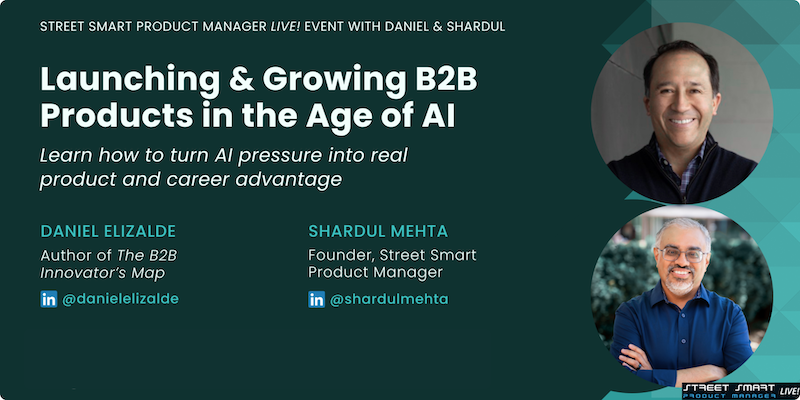
Every leadership team is asking the same question: “What’s our AI strategy?” In my recent webinar with Shardul Mehta, from Street Smart Product Manager, I cut through the noise and focused on the real job of product leaders—connecting technology to business outcomes.
AI is a powerful new toolkit, but the core principles of B2B innovation haven’t changed: we still have to discover real customer pains, design solutions people will pay for, and build a path to profitability.
In the session, I walked through how AI impacts each stage of my book, The B2B Innovator’s Map—from Strategic Alignment through Market/User Discovery, Solution Planning, Prototyping, and landing 10 successful pilot customers.
We talked about how to use AI to accelerate the journey without falling for “success theater” and vanity demos.
 Watch the recording:
Highlights you’ll take away
- Strategy first, tools second. Before you prototype, align on why AI matters to your business—competitive pressure, investor expectations, efficiency, or a real customer pain. The “why” dictates the “what.”
- Discovery still means talking to humans. AI can summarize interviews, but it cannot replace them. If your buyer is human, your insights must be, too.
- Plan for the whole system. Data access/rights, privacy (FERPA/HIPAA), contracts, evaluation/observability, and sales comp all change with AI. Bring Legal, Finance, CS, and Sales in early.
- Unit economics beat hype. Compute, storage, variable “credit” models, and margin impact are as strategic as features. If the value doesn’t pencil out, revisit the approach—or the tech.
- Differentiate with your IP. An LLM wrapper isn’t a product. Your proprietary data and domain workflows are where durable value and pricing power come from.
- Prototype with intent. Use fast experiments to validate problem–solution fit, not to promise finished software. Target paid pilots and test pricing early.
The Bottom Line
If you’re a product leader being asked to “add AI to the roadmap,” this talk gives you a practical way to lead the conversation—grounded in customer value, measurable ROI, and cross-functional readiness.